
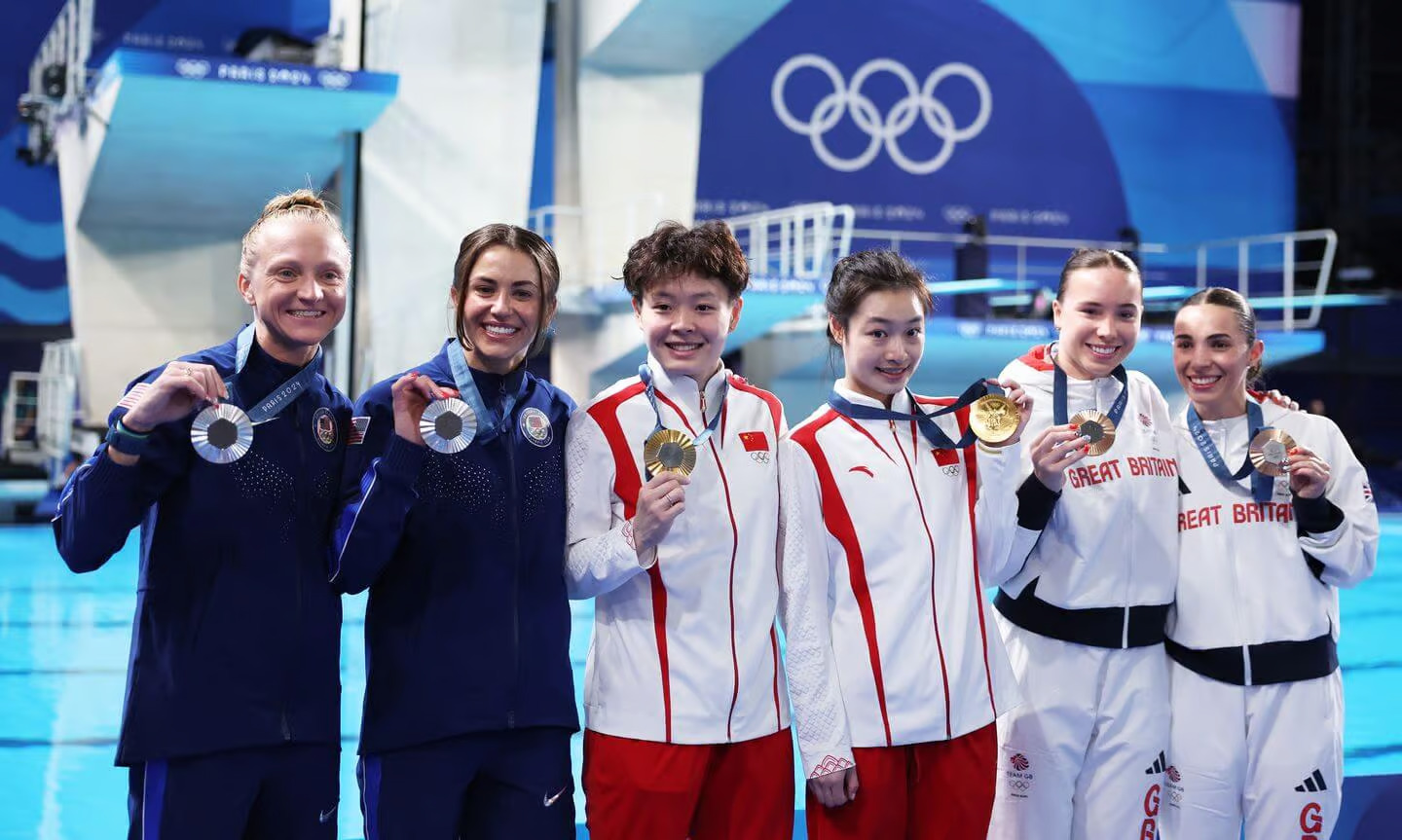
China won its first gold of the Paris Olympics last Saturday in the Women’s Synchronised 3-meter Springboard.
While most will be aware of China’s remarkable modern day Olympics record, few would know the bumpy Olympic paths China have journeyed through since almost a century ago.
A one-man debut and a budget shortfall
In 1932, China attended its first ever Olympics. The mini delegation consisted of only 3 men – the team head, an interpreter and the only athlete Liu Changchun. When the delegation eventually arrived in Los Angeles in late July after a 20-day voyage, American reporters asked Liu to raise both hands high for a photograph. Liu refused. The gesture was an indication of surrender in China, particularly sensitive at that time when China was at war with Japan. It was not until the request was explained to him that he consented. After 20 gruelling days on the sea, Liu struggled to find form and was eliminated in the first round despite his remarkable results in competitions against Russia and Asia athletes.
China next took part in 1936 in Berlin. This time 69 athletes participated in events including track and field, swimming, weightlifting, cycling, boxing, basketball and football. Due to a shortfall of funds allocated by the then Chiang Kai-shek government, the Chinese football team, which had won nine straight victories in the Far East Games, had to leave early to participate in fundraising matches. Their performances and dedication won the hearts of many fans and they raised funds far in excess of the shortfall.
First win in half a century
China continued to participate in the Olympic Games in the following four decades, but only with small delegations due to political situation. Finally in Los Angeles in 1984, China’s lineup included almost 300 people. During the opening ceremony, when Chinese players wearing the national emblem entered the stadium, the host specially played the March of the People’s Liberation Army to welcome them. One can’t help but imagine the contrast if Chinese Olympians were entering the Games in the USA today.
It was the shooting event in the Los Angeles Games that witnessed China’s first ever Olympic gold medal. A Chinese sports official rushed onto the field with tears in his eyes, embracing the 27-year-old Xu Haifeng and praising him for the monumental event in Chinese sports history. In all, Chinese athletes won 15 gold, 8 silver and 9 bronze medals, ranking fourth place on the overall medals list. Since that Games, China has often dominated the shooting, gymnastics, weightlifting and diving events – and later table tennis, badminton and judo.
In November 1998, Beijing bid for the 2008 Olympics, winning with an overwhelming majority. China’s Olympics dream finally came true.
A shared dream and spirit
China’s Olympic dream is shared by its 1.3 million people. I vividly remember watching the Olympics with my parents and grandparents when I was a little girl. We were keen to watch all the games that China participated in despite the time difference. We cheered loudly for every point the Chinese athletes scored. Each time the Chinese national anthem was played in the stadium, my family would stop what we were doing and quietly listen.
From one man to a team of almost 300 athletes ranking in the top places on the medal list, China’s Olympic spirit demonstrated unyielding determination, and should be shared by the world. Olympic sports in China rose against all odds – political instability, lagging economic development and lack of professional training conditions in the not-too-distant past. It is perseverance that enabled these athletes to flourish in their sports.
Perseverance is particularly relevant today when an advanced economy and improved living conditions give our children natural advantages – they outsmart us and many are very talented from a young age. While our children do not need to journey on the sea for 20 days in order to arrive where they need to be, neither do they have to fundraise for any shortfalls our financial conditions cannot stretch to, to do well and thrive in their own “game” they need the ability to persevere. It is only with continued efforts that intelligence and talent become a skill that leads to success.
This is China’s Olympic history and spirit. I am willing and proud to impart it to my child and the future generations.